Five things Suno's lyrics editor does not count
 Silas Moser4 min read
Suno's lyrics editor got good in July 2026. That is worth saying first, because the old advice about writing everywhere except the lyrics box is out of date.
v6, launched on 9 September 2026, goes further. Suno's release note says you can now change one word or line "while leaving the rest intact." That makes counting matter more, because the new word has to fit the notes the old one had.
What changed is how you rewrite a line. What did not change is that nothing on the screen counts anything.
What the editor does now
The July 2026 update, covered on 9 July, describes natural-language editing, where "instead of manually rewriting a line, you type an instruction the way you would talk to a co-writer". Highlight a word for rhyme options, highlight a line for alternate phrasings that riff on it. A Lyricist profile saves your writing style as "a reusable profile you can apply to new songs".
That is a real co-writer, and it is better than what most people were pasting from. The same write-up is clear about the boundary: Suno "is still editing the lyric sheet" rather than the finished waveform.
Rewriting is not measuring
Every one of those features changes words. None of them tells you which words are going to break, which is a different question and the one that costs credits.
Here is a five-line sheet, written for this piece, with a Style field of "indie rock, moody, electric guitar, male vocals, 120 bpm":
[Verse 1]
I have been driving through the neon lights again tonight
and everything I wanted turned to fire
The road is long, the radio is desire

[Chorus]
Say it out loud
Say it out loud
The free Suno lyrics check returns five findings on those five lines, in its own words:
Fix        Line 2   14 syllables. Past 12, Suno starts rushing or dropping words.
                    Split the line in two.
Consider   Line 2   "through" has more than one reading (silent letters).
                    Respell it so it has one: thru.
Consider   Line 2   "neon lights" appears in a large share of AI lyrics.
                    Replace it with something from your own story.
Consider   Line 4   fire / desire: the listener hears the second word before you
                    sing it. Try a slant rhyme or change the first end word.
Consider            The sheet ends on [Chorus]. Add [Outro] or [End] on its own
                    line so the song lands instead of fading out.
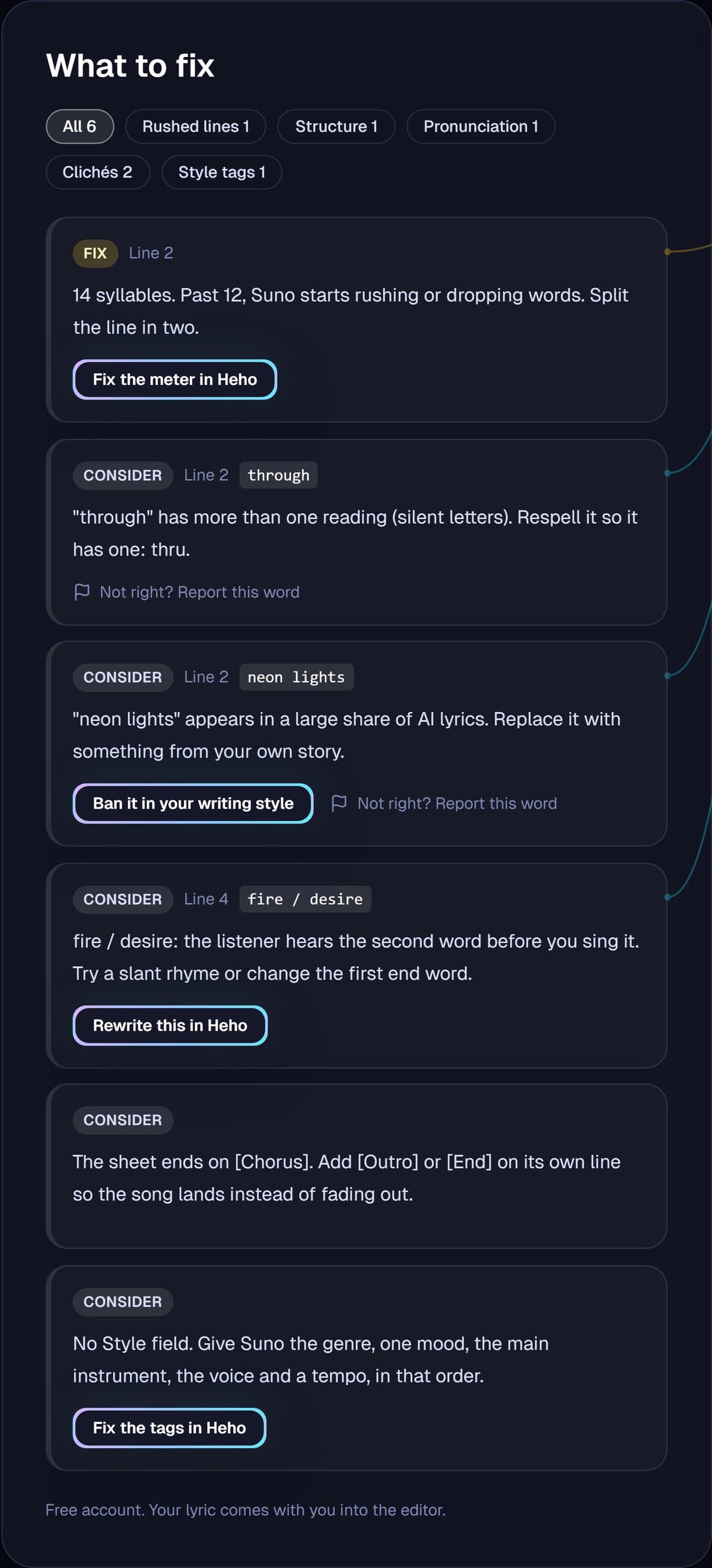
Five kinds of problem, five lines, none of which a rewrite tool would have raised, because none of them is a question about phrasing. The line is long, the word has two readings, the phrase is everyone's, the rhyme is finished, and the sheet has no ending.
Take line two on its own. Ask a co-writer, human or otherwise, to improve it and you will get a better sentence. It will still be 14 syllables, it will still put "neon lights" in the first verse, and Suno will still rush it, because none of that was a phrasing problem. The count is the thing that decides, and the count is what nothing on that screen shows you.
The notes-app objection is the honest one
When somebody proposed a songwriter's workspace on r/SunoAI in November 2025, the replies were not enthusiastic. One writer already uses Obsidian for it. Another pointed out that most of the description is a note-taking app. A third put it more briefly: "Man invents Windows Notepad."
They are right about storage. Any notes app keeps your lyrics, versions and links, and if that is the whole problem then that is the whole answer. It is also why most people who write seriously still draft somewhere else and paste, a habit the July editor makes less necessary than it was but has not removed.
The Lyricist profile is the interesting exception, since it carries something between songs rather than storing it. A saved writing voice is not a measurement either, but it is the first thing in that editor that remembers you.
What a notes app does not do is count. Neither does a text box, however good its rewrite suggestions are, and that is the only distinction being drawn here.
NoteMeasurement is not rare because it is hard. Other tools do parts of it, and a syllable counter has existed for as long as fingers have. What matters is whether the numbers are in front of you before you paste, rather than after you have spent the credits.
What neither tool tells you
Neither shows you where the stress falls. "I never said I would be back" and "Tomorrow morning I will call" are both eight syllables, and they sit against a beat completely differently, because the strong syllables land in different places. A count treats them as identical. A singer does not, and neither does the model. No tool in this piece measures that today, which makes it the most useful thing nobody has built.
Neither knows Suno's real budget for your generation, which is why the length reading is an estimate.
And neither has an opinion worth having about whether the song is any good. The findings above are all things you could have caught by reading carefully, twice, with a pencil. The check saves the reading, not the writing.
Paste your lyrics, it takes ten seconds: heho.ai/tools/suno-lyrics-check