Numbers, years and acronyms in Suno lyrics
 Silas Moser4 min read
Here is a line that looks short:
We met in 2019 outside the DMV
Count it. Seven syllables, and every syllable counter will agree, including the one behind our own check. Now sing it. Thirteen.
A number is not one syllable
Digits are not words, so nothing that counts syllables can count them. "2019" is four characters that a counter skips and a singer turns into "twenty nineteen", four syllables that were never in the total. "DMV" is three letters that get spoken as three syllables.
Written the way it will be sung, the same line reads:
We met in twenty nineteen outside the D-M-V
Thirteen syllables, which is past the point where the Suno lyrics check starts marking a sung line as too dense. The first version passed every check in the tool. The second version is the true one, and it needs splitting.
That is the practical argument for writing numbers out, and it holds no matter how Suno behaves.
What the check prints, and one phrase in it I would not defend
Paste the original and three findings come back:
Consider   Line 2   2019
           Digits (2019) are read differently from take to take.
           Write the number out: twenty nineteen.

Consider   Line 2   DMV
           DMV may be sung as a word. Write it as letters: D-M-V.

Consider   Line 3   3
           Digits (3) are read differently from take to take.
           Write the number out: three.
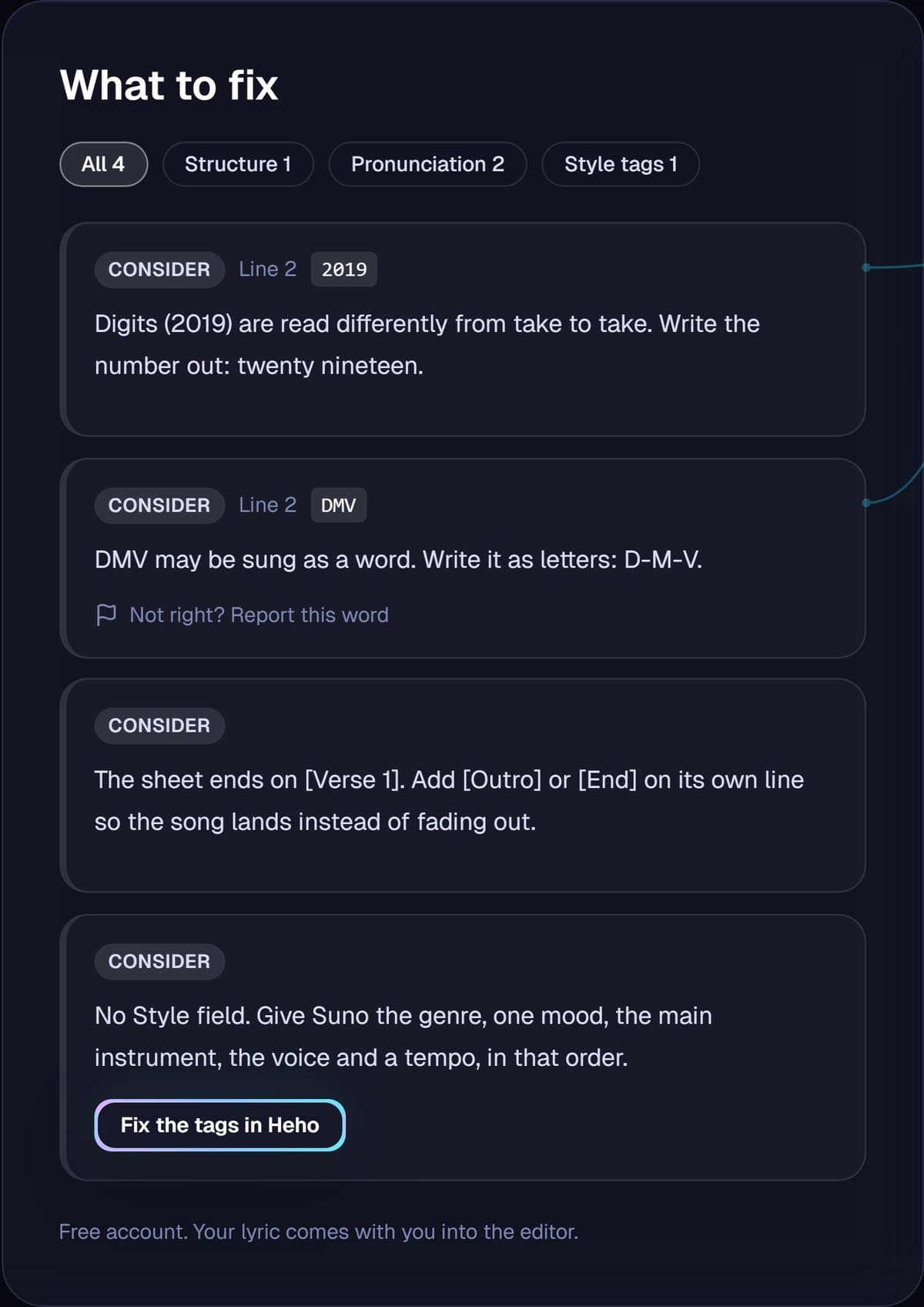
"Read differently from take to take" is our tool's wording and it is stronger than our evidence. No thread in the research behind these articles demonstrates Suno reading the same digits two ways, and we have not run that test either. What is certain is the ambiguity in the text: "2019" has at least three readings in ordinary English, twenty nineteen, two thousand nineteen, and two zero one nine, and they are four, five and five syllables. Writing it out is you choosing, rather than you fixing something known to be broken.
The mechanism underneath is the one people have demonstrated. On the thread asking for a report option, a writer describes respelling a word to force the reading they wanted, which is the same lever: what is on the page decides what is sung. Digits just leave more of that decision open than letters do.
The three places digits turn up
Years are the expensive ones. Any four-digit year is four or five syllables depending on the reading, and it usually sits in a line that was written to a count without it.
Quantities are cheap and still worth writing out. "3" is one syllable as "three", so the line barely moves, and you have removed a decision for nothing.
Times and addresses are the awkward case. "7:45" is "seven forty-five" or "quarter to eight", five syllables or four, while "Route 9" is "route nine" and stays put. Write whichever one you would say out loud, then recount the line, because that is the number that was always going to be sung.
Acronyms are two decisions, and the check only makes one
An acronym can be said as letters, F-B-I, or as a word, NASA. The check assumes letters and offers the hyphenated spelling, which is right most of the time and wrong for exactly the ones that have become words.
Both readings change your count. "DMV" as three letters is three syllables where the unwritten version contributed one, and "NASA" is two. So an acronym in a chorus line is worth resolving on the page before you find out which way it goes.
If you want the letters, hyphenate them. If you want the word, write the word: "nasa" in lower case looks wrong and sings right, which is the same trade every respelling asks for, and the rest of it is in which words Suno will mispronounce.
TipDo this before you count anything. A sheet with digits in it has a syllable total that is quietly wrong, and every meter decision you make on top of it inherits the error.
What this does not settle
It does not tell you how Suno reads a digit today. Nobody has published that test, ours included, and this article is not going to imply otherwise.
It does not apply to the title or the description, where a year is read rather than sung. Write those normally.
And it does not make a number a good idea. A date in a lyric is specific, which is usually a strength, but four syllables of "twenty nineteen" in a chorus is a lot of room to spend on a fact the listener may not need.
Paste your lyrics, it takes ten seconds: heho.ai/tools/suno-lyrics-check